
P&PM Axis — by P&PM Solutions
A construction operating system where the schedule runs the company.
Axis is built for spec and custom home builders, at any volume. It takes the critical-path methodology used to schedule industrial projects and connects it to the departments that actually have to act on it. The schedule does not sit in a file waiting to be read. It tells each person what has to happen and when, and it updates everyone the moment anything moves.
The first question
Do your finance and project teams actually speak to each other? How much time do they lose connecting one side to the other?
Most home builders run schedules in one place and money in another. The two teams meet once a week, reconcile what they can, and guess at the rest. Axis was built so the schedule and the books share the same facts in real time.
The three cores
Three cores, and everything else runs off them.
01
Operations management
The schedule, on the critical path, for every project at once. Tasks assigned with dates to the people and trades who have to do them. Progress marked in the field, not transcribed in the office afterwards.
02
Finance
Budgets, commitments, invoices, payments and cash flow tied to the same tasks the schedule is tracking. A cost is attached to the work that caused it.
03
Accounting
The books built from the same records, not rebuilt from them. Work in progress, P&L and balance sheet come out of what the field and the office already entered.
Feasibility, procurement, production, quality control, sales, closings and warranty all run off these three. What one department does, the others see live.
Getting started
You start from the files you already have.
No builder can stop running to adopt a system. So Axis begins by taking in the project management records a company already keeps, on whichever platform it keeps them. The system recognises what the information is, associates it across every department, and comes up ready to work. Getting started is an import, not a rebuild.
- 01Step
Bring what you already have
Existing schedules, budgets and job files import from the platforms builders already run. Nothing is typed in twice, and nothing is left behind in the old system.
- 02Step
The system reads it
Activities, dates, costs, vendors and job records are recognised and matched to each other, not re-keyed. What was a set of separate files becomes one connected record of the company.
- 03Step
Departments connect
Operations, finance and accounting come up pointing at the same records, so the company starts working on day one instead of spending a quarter rebuilding its own data.
93%
Average baseline achievement, every house built since 2024
Across every house we have built since 2024, 93% of scheduled activities finished on or before their baseline date. That is the number this whole system exists to produce. A schedule nobody follows is a document. A schedule the company runs on is an asset.
Where it comes from
Two methodologies, put together.
The schedule
The scheduling engine follows the critical-path methodology of Primavera P6, which is the best CPM tool ever built. I spent nine years scheduling projects from $220 million to R$1 billion with it, and a year implementing it inside Petrobras. P6's weakness is not the maths, it is the isolation — the schedule lives in the scheduler's file and the rest of the company never touches it. Axis keeps the maths and removes the wall.
The money
The financial side follows the accounting methodology of QuickBooks, so operations and finance speak the same language automatically. Nobody re-keys anything, and nobody reconciles two systems at month end.
What it looks like
The system.
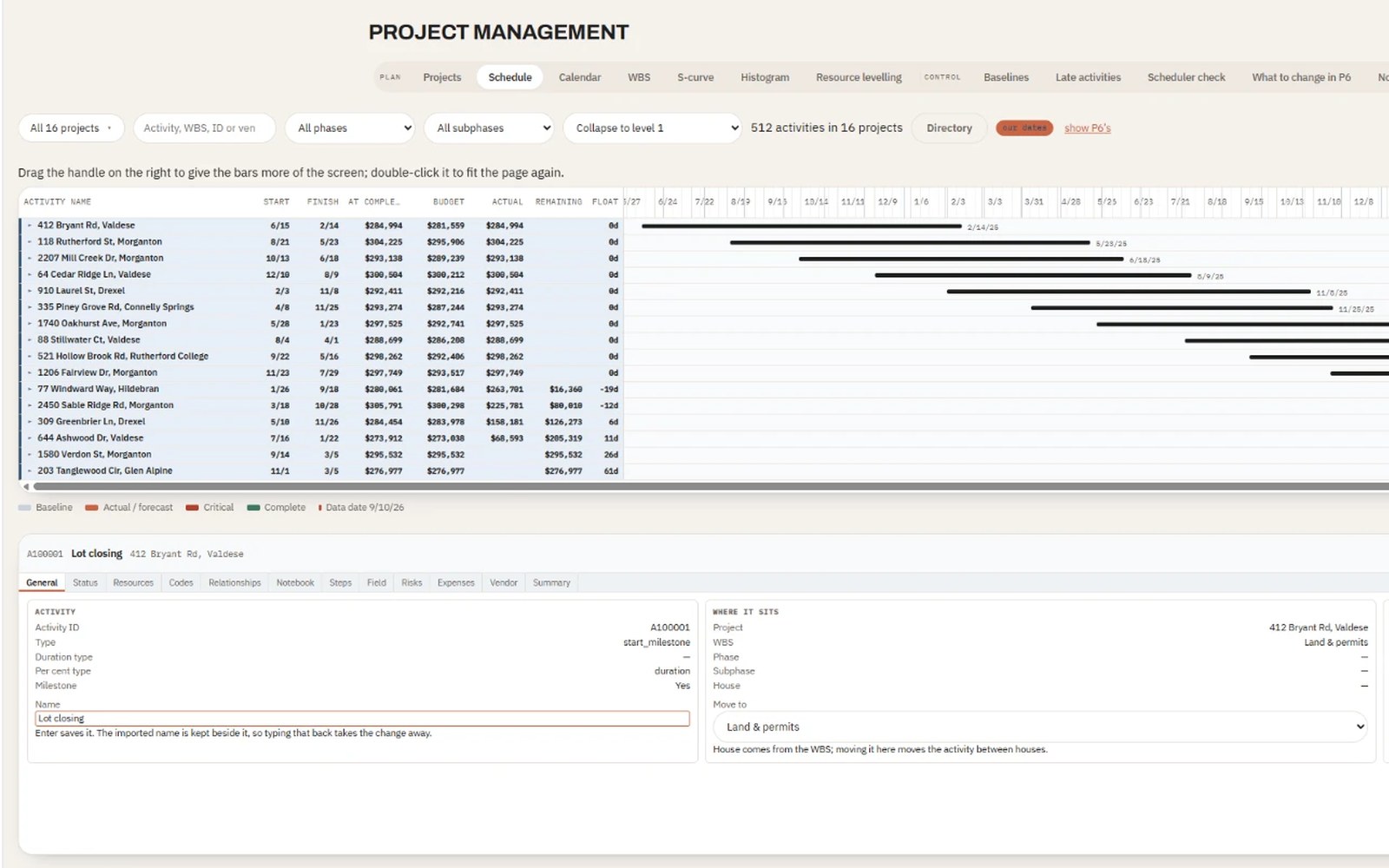
Every project on one critical path.
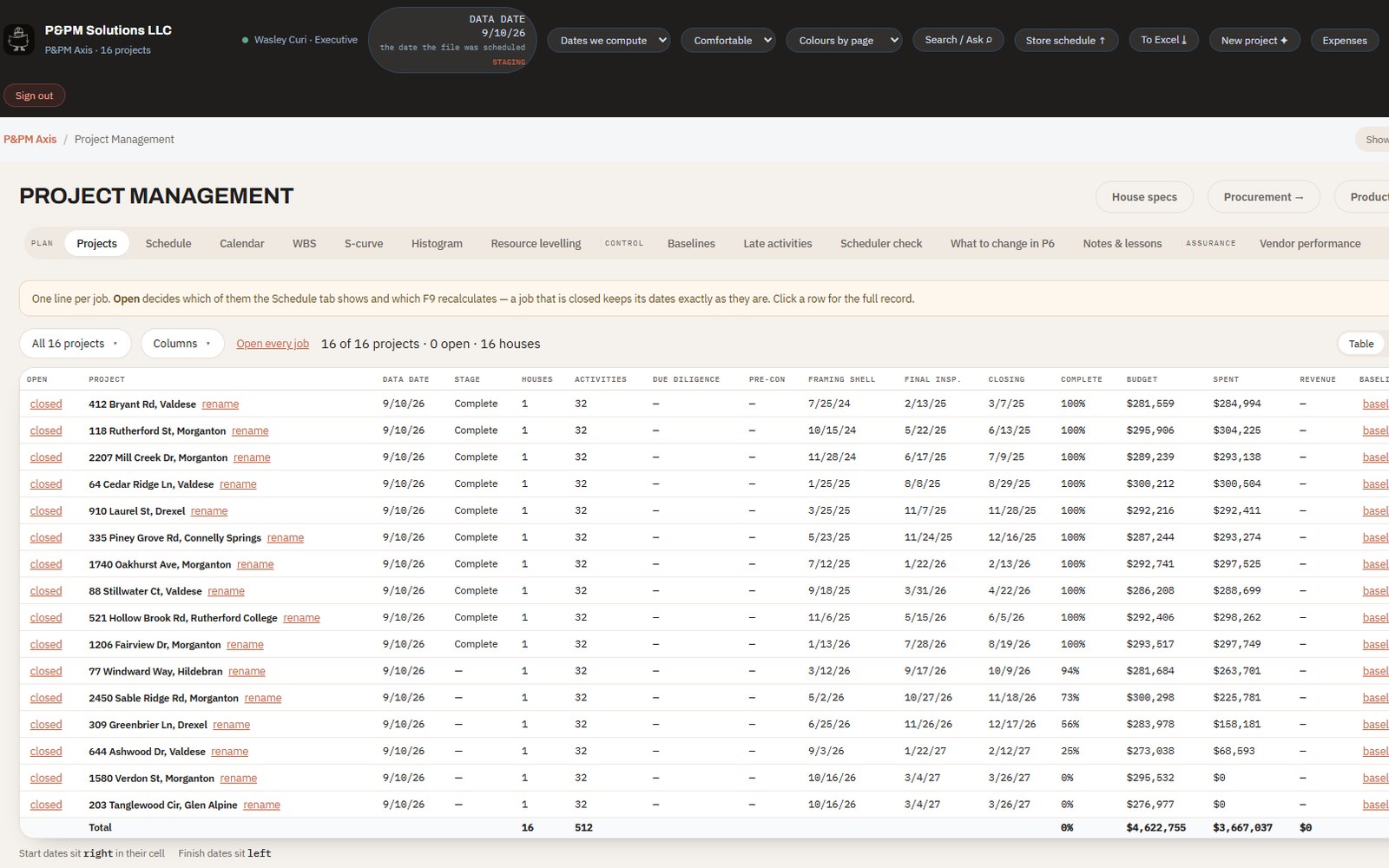
Every house, its stage, its dates and its money on one line.
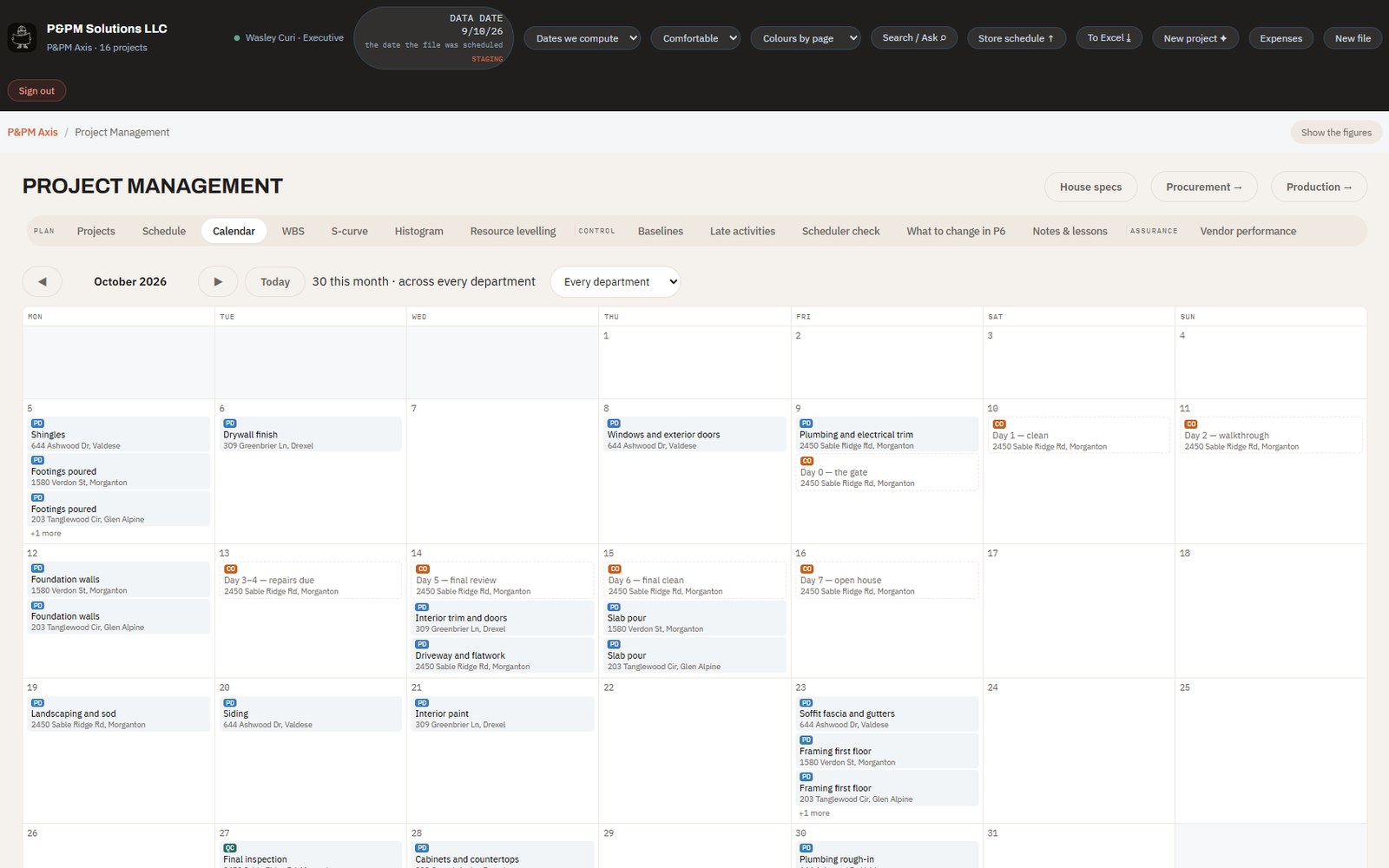
What each trade has to do, and when, across every department.
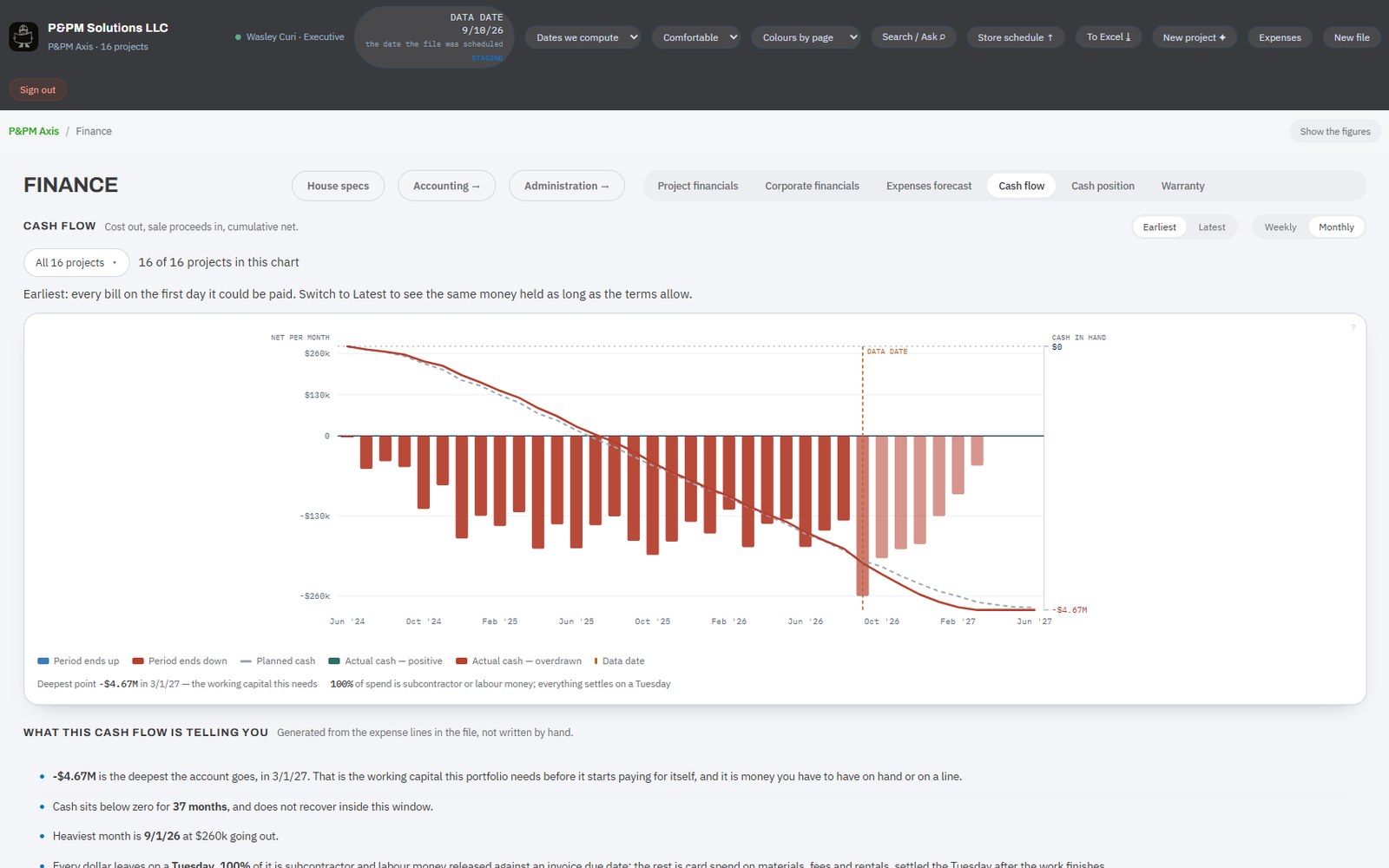
Cost out and sale proceeds in, cumulative, off the same schedule.
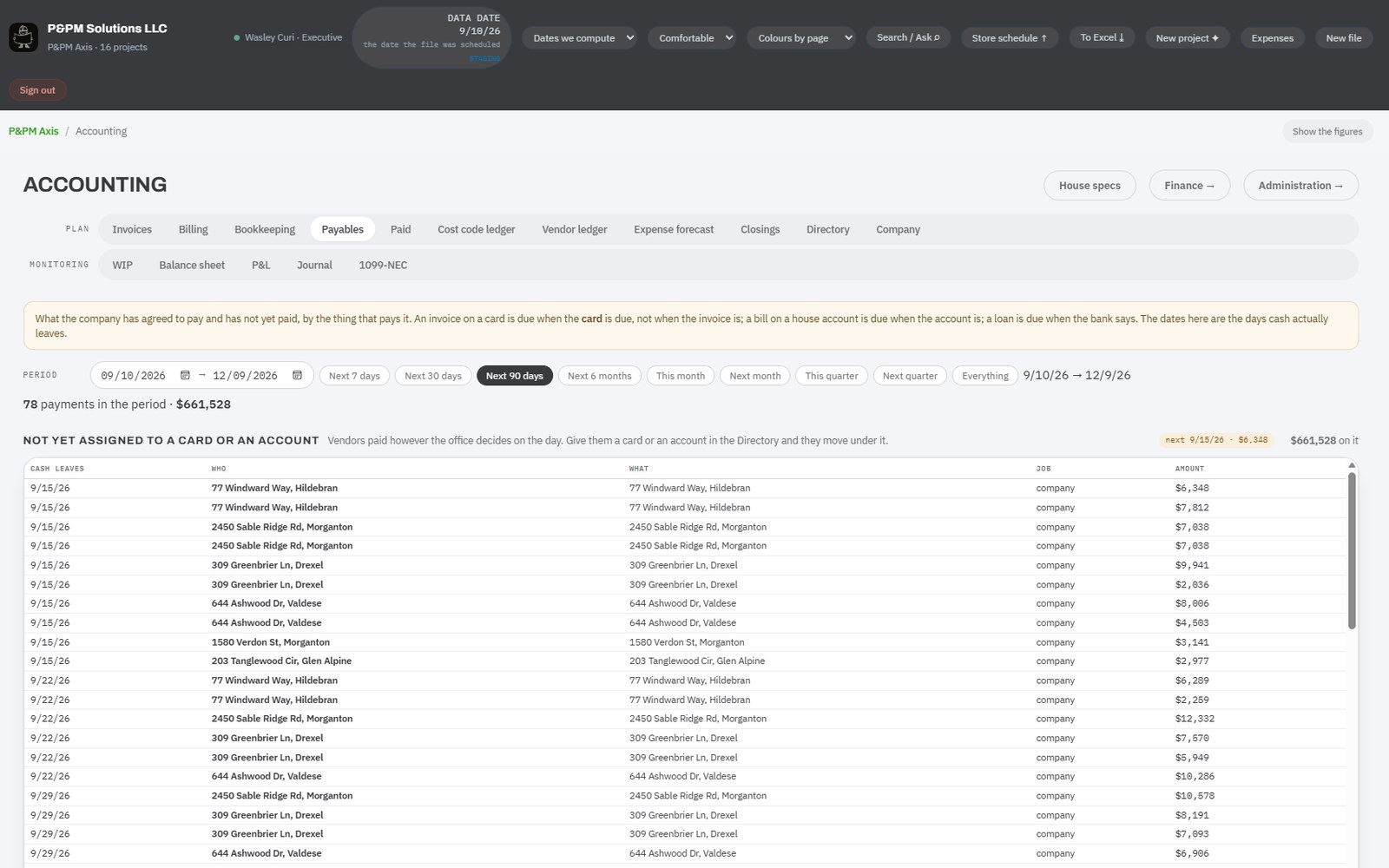
What the company has agreed to pay and has not yet paid, by the thing that pays it.
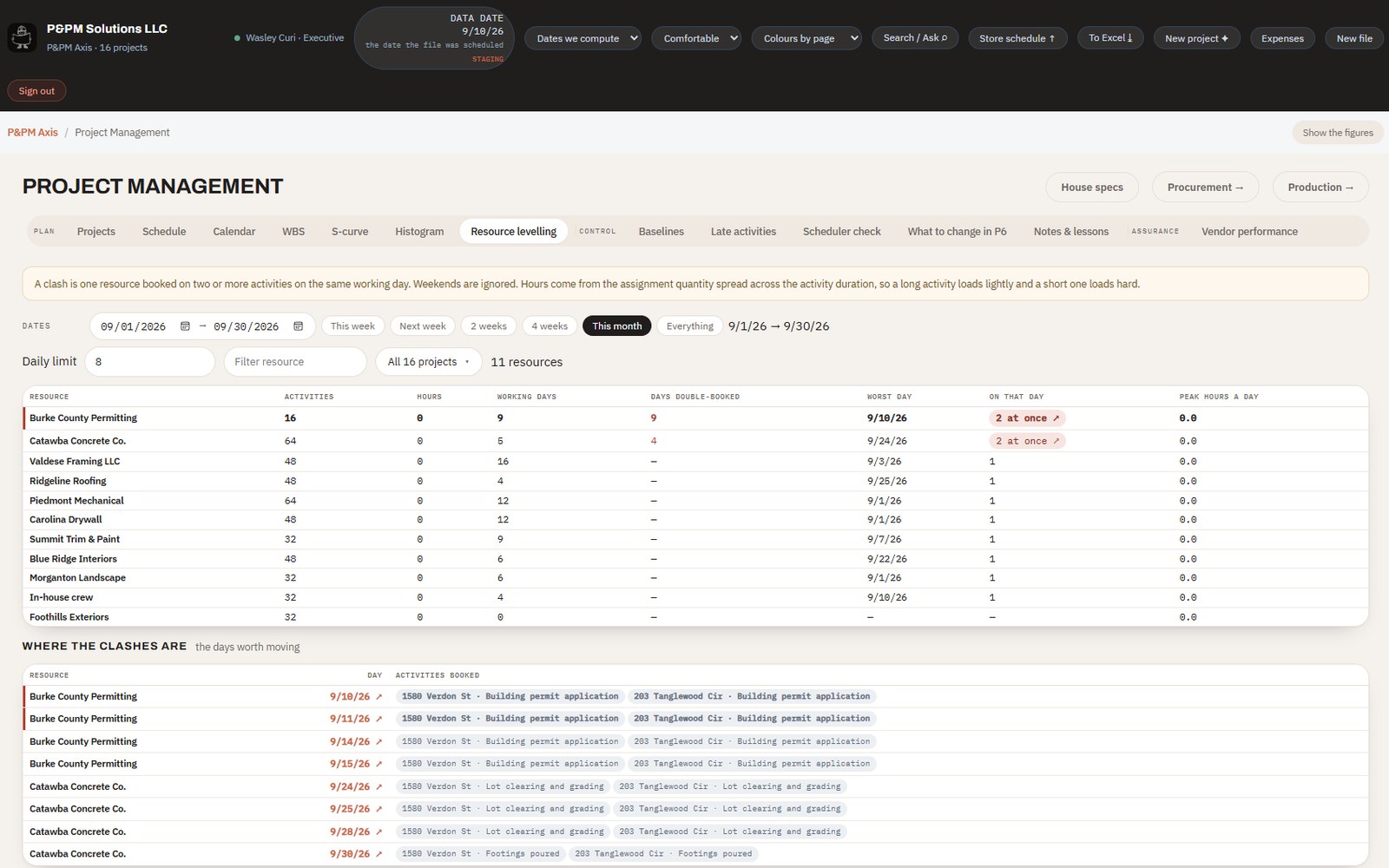
One resource booked twice on the same day is flagged before it costs a week.
We didn't build this to sell it. We built it because we needed it.
Axis runs P&PM Solutions LLC. Our lot pipeline, our feasibility, our procurement and delivery checks, our production and quality control, our invoices and payments, our closings and our warranty book all live in it. It replaced Primavera P6 as our scheduler. Every schedule assumption in it has been tested against a real house with a real trade waiting on a real morning.
Status
Not available yet.
Axis is roughly 70% built. It runs our own company and it is not sold, licensed or available to anyone else. When it opens, it will open to a small number of builders, not to a signup page. If you build spec or custom homes and you want to know when that happens, leave your details and I'll write to you myself.
No mailing list, no product updates. One email, when there's something to say.